
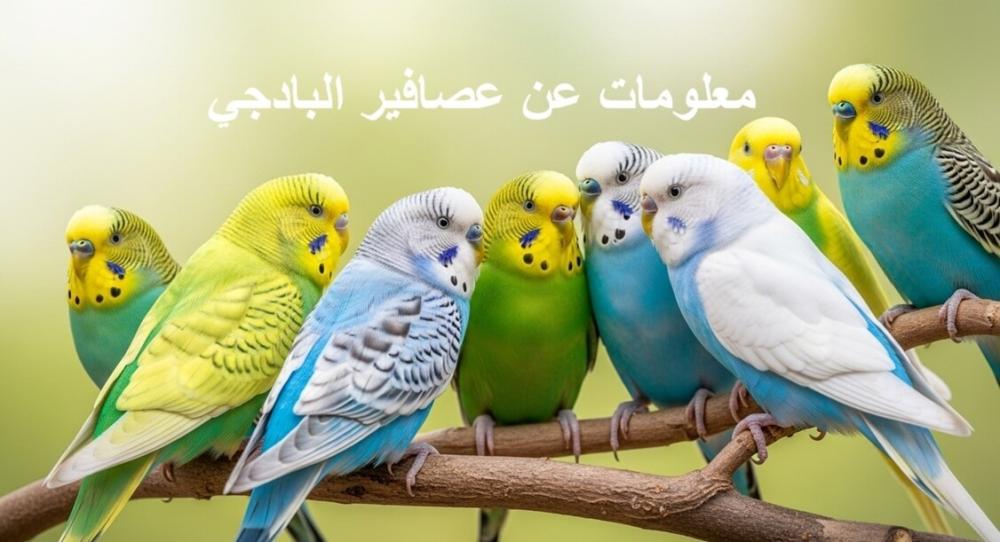
Budgies , small parrots, are charming and intelligent birds that have captured the hearts of bird lovers worldwide. In this article, we will discuss in detail information about budgies, including their main characteristics, lifespan, behavior, and care considerations.
Main characteristics of budgies:
Common names worldwide and in the Arab world:
- Budgie: This is the most famous name worldwide, and it is an abbreviation of the bird's original name, Budgerigar.
- Al-Budjariqa: This is the literal Arabic transliteration of the English name and is often used in scientific books or encyclopedias.
- Parakeet: This name is widespread in many Arab countries (such as Egypt and the Levant), and is sometimes used for other types of small parrots, but it is closely associated with budgies.
- Lovebird: Although lovebirds are a different species (smaller in size and with a stronger beak), it is the most common name in Saudi Arabia for budgies because of the affection and camaraderie that appears between their pairs.
colors:
Budgies come in a wide variety of colors, including blue, green, yellow, and white. Their attractive plumage makes them charming pets that add beauty and elegance wherever they are.
Size and weight:
These relatively small parrots are about 6 to 8 inches (15 to 20 cm) long and weigh about 1 to 1.4 ounces (28 to 40 grams).
Average age:
Budgies typically live between 5 and 10 years. However, with proper care, some can live up to 15 years or more.
What are the different types of budgies?
If you do not delve into research about budgies, you will not find that there is a clear difference in the types of budgies. Scientists and breeders classify them based on size or color mutations.
Types of budgies according to size and breed:
The classification that differentiates between the bird's physical structure:
Australian budgies:
- It is the original and most widespread type.
- It is characterized by its small size, high activity, and great production capacity.
- It is affordable and easy to raise for beginners. The price of a pair ranges between 180 and 220 riyals.
English budgie:
- It was developed in Britain through the selection of large breeds.
- It is characterized by its large size (almost twice the size of the Australian).
- The head feathers are so dense that they may cover the eyes and beak.
- It moves less and is calmer, and is often acquired for competitions.
- Its price is more expensive than its Australian counterpart, reaching up to 500 riyals.
The Hojoromo Budgie (Japanese):
- In Arab markets it is known as Al-Hujo.
- It is characterized by having feathers that grow in a circular pattern on the back and wings, resembling a "rose".
- It is considered one of the most sought-after aesthetic (ornamental) types.
- Its price ranges between 350-600 riyals.
Types of budgies according to color mutations:
The normal budgie:
Which has the traditional black stripes on the wings and head.
Opaline:
Where the black lines disappear from the head and back area, so that the basic color (green or blue) becomes dominant.
lutino:
A bird that is entirely yellow with red eyes.
Albino:
A bird that is entirely white with red eyes.
Rainbow:
It is considered one of the most beautiful species, and it is a combination of several mutations that result in a bird with rainbow colors (yellow face, sky-blue body, and light-colored wings).
Information about budgies related to their behavior and personality?
Information about budgies in terms of /span>
Social :
Budgies are flock birds, meaning they never like being alone.
Living in pairs: It always prefers to have a mate. If the bird is alone, it will consider its owner as the replacement member of the flock and will become very attached to him.
Interaction: Budgies spend a lot of time cleaning their partner's feathers, a behavior that expresses affection and bonding.
Intelligence and the ability to speak:
Despite its small size, the budgie is considered one of the smartest parrots.
Imitation: Male budgies in particular have an amazing ability to memorize and imitate words and short phrases in a high-pitched voice.
Curiosity: It likes to explore new things with its beak, and tends to play with toys that contain bells or mirrors.
Body language and how to understand a budgie?
Budgies express their feelings through specific body movements:
Fluffing feathers and shaking the body: a sign of relaxation or stress relief. However, if the feathers remain fluffy for an extended period along with lethargy, it could be a sign of illness.
Beak rubbing (squeaking): If you hear your bird making a quiet pecking sound before going to sleep, it means that it feels safe and completely happy.
Dilation and constriction of the pupils: a sign of intense enthusiasm or concentration, and sometimes a sign of anger if accompanied by aggressive movements.
Standing on one leg: The bird's comfortable sleeping position, indicating that it is in good health and psychologically stable.
Daily activity and energy levels:
Morning: This is the peak time for activity, when budgies start chirping loudly and hopping between perches.
Napping: Budgies usually take short nap breaks during the day.
Biting: Budgies are peaceful birds by nature, and only resort to biting if they feel extremely frightened or to protect their nest (especially females).
Behavioral differences between males and females:
Males: They are often more energetic, socialize more quickly with humans, and are more inclined to tweet and mimic.
Females tend to be calmer and more serious, have a strong instinct to gnaw on wood and objects (to prepare the nest), and may be slightly more aggressive during the mating season.
What do budgies eat?
- Budgies are relatively inexpensive to care for and feed due to their small size; however, a budgie's diet should be varied, as a system consisting only of seeds is not a good system and can expose them to health problems.
- Veterinarians recommend that budgie food should contain sufficient and varied nutrients, including fruits, fresh vegetables and leafy greens, with seeds and grains being part of the diet and not its foundation.
- It should be noted that the mating stage does not require changing the feed usually used, but a side meal rich in protein should be provided, such as food containing eggs.
- The most important information about budgies is their balanced diet. Provide your lovely bird with ready-made mixes specifically formulated for them:
Perlina Stepo eats budgies:
- A balanced meal rich in beneficial nutrients.
- It contains natural ingredients.
- It supports feather health, digestion, skin, and immunity.
- It contains natural xanthophylls that promote feather pigmentation.
the components :
Various millet, oilseeds, sunflower seeds, peanuts, canary seeds, grains, rice, oats, colored biscuits.
Vitacraft Budgie Food:
- With high-quality seeds and grains, aromatic eucalyptus leaves and tasty carrots, the mix is ideal for the nutritional needs of budgies.
- Vitamins, minerals and essential elements help in the optimal management of animals.
- The precious honey and healthy cod liver oil, rich in vitamin A and vitamin D, also complement the varied main diet.
- The ideal balanced content of essential vitamins prevents deficiencies and promotes the health of your bird.
What foods are forbidden for budgies?
- Avocado: It is considered very toxic to birds.
- Chocolate and caffeine: cause heart attacks in birds.
- Onions and garlic: affect red blood cells.
- Salt and processed sugars: lead to kidney failure and extreme obesity.
- Fruit seeds (such as apple and mango seeds) contain substances toxic to birds.
Budgie breeding:
- Breeding budgies is one of the most enjoyable experiences for breeders, given their rapid reproduction rate and ease of mating under suitable conditions. Breeding begins when the birds reach sexual maturity (around 8 to 10 months old), with signs of readiness appearing as the area above the beak changes color to dark blue in males and dark brown in females. Producing budgies requires a cage of sufficient size to allow the female to begin laying eggs at a rate of 4 to 8 eggs, approximately one every two days.
- The incubation period for the eggs lasts about 18 to 21 days, during which the female takes over the entire task while the male feeds her and protects the nest.
- After hatching, the chicks emerge weak and featherless, and depend entirely on their parents for nutrition through bird milk and then digested grains.
- During this period it is essential to provide soft meals for the parents to ensure that the chicks grow quickly and strongly. The young are usually weaned when they reach 30 to 35 days old, at which point they become able to be self-reliant and eat solid budgie food independently.
How does the Seventh Bird Shop help you provide the best care for your bird?
Providing the best types of budgie food:
Soft meals and ready-to-serve pâtés designed to support birds during the production period.
Rewards such as grain sticks with honey help improve the bird's mood.
Gold Wings Budgie Treats Honey Sticks 60g
Fasip Budgie Bird Food, High-Quality Seed Mix, 700g
Providing the ideal residential environment:
Cages in various shapes, colors, and sizes
Cage accessories: from natural wooden perches to protect budgie feet
Food and beverage containers specially designed to prevent food contamination
Nutritional supplements and healthcare:
Vitamins and amino acids are added to the water to boost immunity and feather shine.
Calcium and mineral salts, such as those found in squid bones, are essential, especially during egg-laying.
Bird games and activities:
The store provides a variety of toys. Since the budgie is an intelligent, social, and active bird, it is essential to provide all kinds of toys that keep it happy, active, and energetic.
Providing information about budgies:
This is the result of thorough experience and knowledge of all the problems you may encounter on your journey with the budgie.
Conclusion:
In conclusion, you have learned all the information you need to begin your journey with budgies. Raising budgies is a fun and colorful experience. These intelligent and social creatures can transform a home and build a unique bond with their owners. Your success in acquiring exceptional budgies depends primarily on understanding their needs, providing them with a balanced diet, and ensuring a healthy environment.
Frequently asked questions:
How do I know if my budgie is sick?
There are clear signs of illness, including: constant lethargy, prolonged ruffled feathers, loss of appetite, changes in droppings, or discharge around the beak and eyes. If you notice these signs, you should isolate the bird immediately and consult a veterinarian.
Can a budgie live alone?
Budgies are very social birds. They can only live alone if you spend a great deal of time each day playing and talking with them; otherwise, they will become depressed. It's always best to keep them in pairs.
Why does a budgie tremble?
Shivering can be caused by fear, cold, or fatigue after flying. If the shivering is accompanied by the bird drawing its wings up to its body, it may be cold and need to be moved to a warmer place.
Can budgies talk?
Yes, especially the males. Budgies have an excellent ability to imitate simple words and sentences if they are trained at an early age (from weaning) with patience and daily repetition.
Can budgies get fleas?
No, parrots don't usually get fleas. Their feathers and grooming habits make it difficult for fleas to infest them. Regular cleaning of their living area also prevents potential pests from entering.